Spicy salami – fruity, smoky, and fiery


- Type
- Cured sausage
- Level
- Advanced
- Rating
- Rate this recipe
In this post, you’ll learn how to make your own spicy salami. Three different chilies create a complex flavor profile: the fruity depth of the ancho, the smoky note of the chipotle, and the serious heat from the bird’s eye.
As a dry-cured sausage, salami is one of the most challenging types of sausage to make yourself because you have to manage the reddening and subsequent curing processes carefully. If you haven’t made salami before, be sure to read my comprehensive guide on making salami yourself first; there you’ll find the complete curing chart and all the basics.
If you like other spicy raw sausages, check out my chorizo or Hungarian salami. For a really spicy kick as a bratwurst, there’s also the Feuerwurst.
Here you’ll find the complete spicy salami recipe as a video or to read through. Have fun and good luck making it!

Table of Contents
Spicy salami – What do you need to make it?

Ingredients per 1 kg
| Ingredient | Grams | Percent |
|---|---|---|
| lean pork shoulder | 750 g | 75 % |
| pork back fat | 250 g | 25 % |
Spices per 1 kg
| Ingredient | Grams |
|---|---|
| salt | 31.5 g |
| fresh garlic | 5 g |
| sweet paprika | 4 g |
| dextrose / sugar mixture – 50 % dextrose / 50 % sugar | 3 g |
| ancho chili | 3 g |
| chipotle chili | 3 g |
| Cure #1 | 2.5 g |
| bird's eye chili | 2 g |
| black pepper | 2 g |
The equipment to make spicy salami
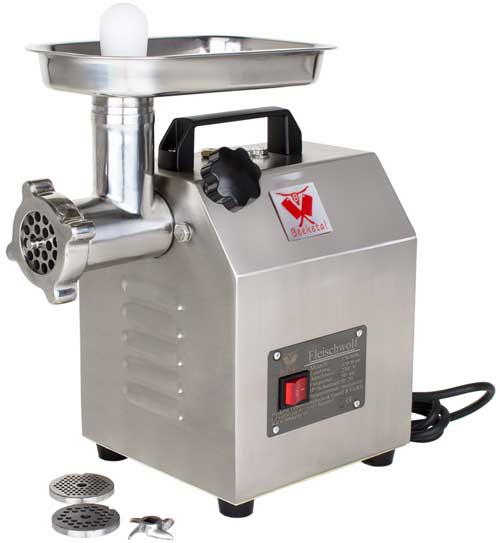
A meat grinder cuts the meat into small pieces so it can be mixed with the seasoning. Cut the meat into pieces that fit the feed tube before grinding.

Sausage stuffer, grinder attachment or funnel
Use a sausage stuffer to fill the mixture into its casing. A stuffing attachment for your meat grinder or a hand funnel also works when you are starting out.
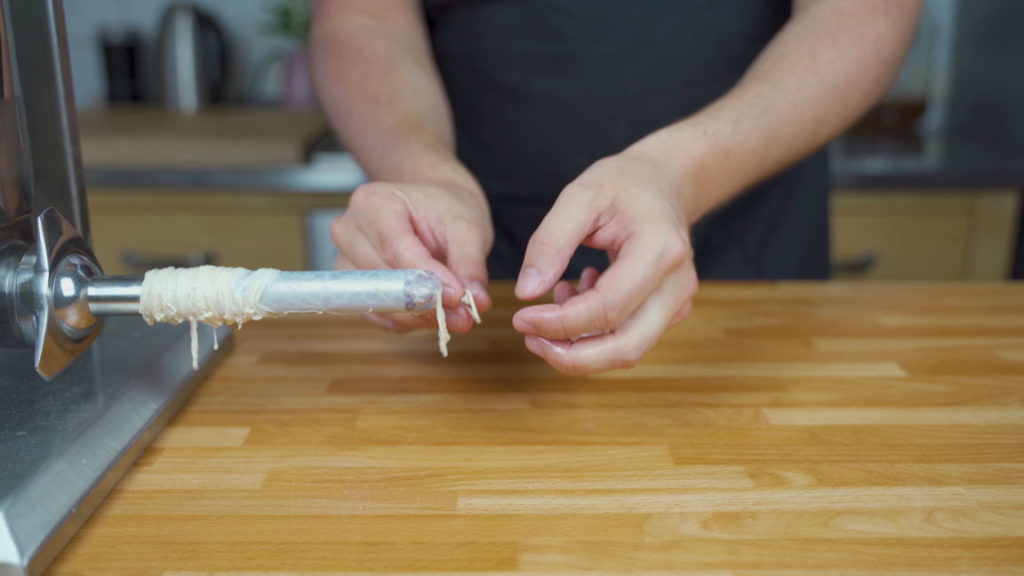
Smokable fibrous casings
For maturing raw-cured sausages, I recommend smokable fibrous casings, caliber 55/25. They support the drying and maturation process.
For readers in the EU: you can buy these casings in my German shop. Smokable fibrous casings, caliber 55/25, 5 pieces.

Place to dry and mature the sausage
To age this raw sausage, you need an environment where both humidity and temperature are relatively constant. There are several possibilities for this. I have already matured cured sausages in the fridge or cellar without any problems.
Optional: If you want to be on the safe side, then a ripening cabinet is the best choice. My recommendation: Dry Ager DX 500
Spicy salami – Step-By-Step Instructions
Cut the lean pork shoulder and the back fat separately into pieces suitable for a meat grinder. Cut the fat into slightly smaller pieces than the meat so that it distributes evenly in the sausage mixture later and doesn’t form lumps. Pay attention to the ratio: 75% lean to 25% fat—this gives the salami its characteristic marbling.

Put the meat pieces in the freezer for 1-2 hours to freeze. This will help you later with the mincing and ensures that the mass does not get too warm.

Grind the frozen meat and pork back fat once using the medium-sized plate. The medium-sized plate is my favorite for this salami: fine enough for a clean cut surface, yet coarse enough that the bacon bits remain visible when you cut into it. It’s a matter of taste—if you prefer a finer texture, you can of course use the fine plate instead.

Add the salt, the cure #1, sugar mixture, black pepper, sweet paprika, freshly chopped garlic, and three chili peppers to the ground meat mixture. Knead the mixture vigorously for about 3 minutes. You’ll know it’s reached the right consistency when the mixture sticks to your hands and you see slight streaks of fat. Tip: If the mixture isn’t properly bound, the salami will crumble when sliced later, so it’s better to knead it for half a minute longer than not long enough.

Use the sausage stuffer to fill the sausage meat tightly and with a firm pull into the smokeable synthetic casing, size 55. Wait until the mixture starts to come out of the front of the casing, then tie off the front end with kitchen twine and fill the salami to the desired length. Important: Any air bubbles in the sausage meat can oxidize later and cause mold to form from the inside, so be sure to fill it very tightly. If you want a thinner version, you can also use 28/30-caliber pork casings; the salami will then cure faster.

Hang the salami for 48 hours at 24–25 °C (75–77 °F) and 90% humidity. During this phase, the reddening process begins: the nitrite curing salt reacts with the meat, giving the salami its deep, rich red color. If you don’t have a curing cabinet, you can hang the salami in a warm room and sprinkle it with boiled water to maintain high humidity.

After the reddening phase, lower the temperature to 15 °C (59 °F) and set the humidity to 65–70%. During this phase, the salami slowly loses moisture, the flavor becomes more concentrated, and the spiciness and smoky notes of the chipotle become more pronounced. Make sure the salami dries evenly: if a hard, dry crust forms, the humidity is too low; if the sausage becomes moist and sticky on the outside, it is too high. Allow for about 8 weeks of curing time. A thin version in 28/30 pork casings is ready to slice after just 3–4 weeks; thicker sizes take correspondingly longer. Be patient—it will reward you with its full flavor.

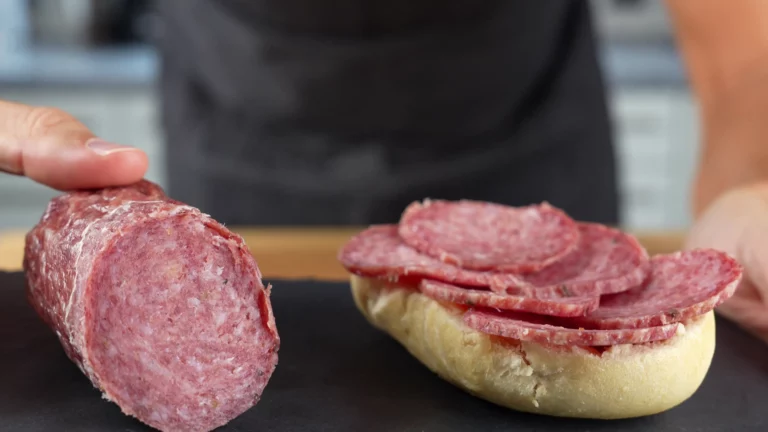
Slice the salami into thin slices and take a bite. First, you’ll taste the fruity notes of the ancho, followed by the smoky flavor of the chipotle, and finally the crisp, spicy kick of the Birdseye. Your spicy salami is ready. Enjoy! 🙂
Where does the heat in a spicy salami come from?
The heat sits in the sausage meat, not on it. All three chilies go in dry alongside the salt, the cure and the rest of the spices in step 4, and they are kneaded through the mixture before it ever reaches a casing. Nothing is rubbed on the outside and nothing is added later, so what you taste in a finished slice is what you weighed out at the start.
What does change is the concentration. Over the drying weeks the salami loses moisture while the chilies stay exactly where they are, so the same dose reads sharper in the cured sausage than it did in the raw mixture. That is the effect step 7 describes when it says the spiciness and the chipotle’s smoke become more pronounced as the salami dries. If you want to move the heat, move it in the spice list before you knead, because afterwards there is no way back.
Frequently Asked Questions About Spicy Salami
How long does spicy salami have a shelf life?
How long does spicy salami have a shelf life?
If your spicy salami has been properly cured and fully matured, it will keep for several months when hung in one piece in a cool, dry place. Once cut, it will keep for about 3–4 weeks in the refrigerator if wrapped in plastic wrap or vacuum-sealed.
Which chilies make the best blend for a spicy salami?
Which chilies make the best blend for a spicy salami?
I deliberately mix three different chilies because each brings a different character: Ancho provides the fruity base, Chipotle adds smoke and depth, and Birdseye delivers the actual heat. If you want it even spicier, increase the Birdseye to 3 or 4 g. Prefer it milder? Leave out the Birdseye and use 1 g more Ancho instead.
Can I make spicy salami without a curing cabinet?
Can I make spicy salami without a curing cabinet?
Yes, it’s possible with a little improvisation. For the reddening process, hang the salami in a warm room (heating basement, utility room) for 48 hours and sprinkle it regularly with boiled water. A cool cellar room with temperatures below 15 °C is suitable for aging. Check daily for mold growth and wipe away any unwanted mold with vinegar water.
Why is my spicy salami crumbly when I cut into it?
Why is my spicy salami crumbly when I cut into it?
A crumbly salami almost always has a weak binding. Either the sausage meat was already too warm when kneading, or you didn’t knead it long enough. Next time, knead vigorously for at least 3 minutes until light streaks of fat appear, and keep the sausage meat at a consistent temperature between -2 and +2 °C. Also important: measure the nitrite curing salt correctly, as the salt plays a key role in protein breakdown and thus the binding.
How spicy will the salami be using this recipe?
How spicy will the salami be using this recipe?
With 2 g Birdseye, 3 g chipotle, and 3 g ancho per 1 kg of sausage meat, you’ll get a properly spicy but still enjoyable salami: a noticeable kick of heat without bringing tears to your eyes. If you prefer it milder, halve the Birdseye. If you want real fire, double it.