Bavarian beer liverwurst – creamy, spicy, with a subtle hint of beer


- Type
- Pre-cooked sausage
- Level
- Medium
- Rating
- Rate this recipe
In this post, I’ll show you how to make your own bavarian beer liverwurst. Creamy, spicy, with a subtle hint of beer in the background: bavarian beer liverwurst is a true Bavarian snack classic and, for me, belongs on every proper snack platter alongside Obazda, radish, and pickled cucumber. Preserved in a jar and kept in the fridge, it is always ready for a spontaneous snack.
My Bavarian Brotzeit guide has ideas for serving this liverwurst. You can also browse all my liverwurst recipes.
The recipe is of moderate difficulty: you’ll work with two cooking stages, a meat grinder, and Cure #1, but the result will reward you with a sausage you won’t find in the supermarket. If you’re just getting started with this topic, check out my post on making your own classic liverwurst. If you love liverwurst, I also have other liversausage recipes for you: my veal liverwurst, my pfälzer Liverwurst and my apple and onion liverwurst.
Here you’ll find the complete bavarian beer liverwurst recipe as a video or to read through.
Have fun and good luck making it!

Bavarian beer liverwurst – What do you need to make it?

With the right ingredients and a little patience, you can whip up this specialty in no time.
Ingredients per 1 kg
| Ingredient | Grams | Percent |
|---|---|---|
| marbled pork | 350 g | 35 % |
| pork cheek, dewlap or back fat | 350 g | 35 % |
| pork liver | 300 g | 30 % |
Spices per 1 kg
| Ingredient | Grams |
|---|---|
| light beer | 75 g |
| braised onions | 50 g |
| salt | 17.5 g |
| Cure #1 | 2.5 g |
| black pepper | 2.5 g |
| marjoram | 2 g |
| mace | 0.5 g |
| cardamom | 0.5 g |
The equipment to make bavarian beer liverwurst
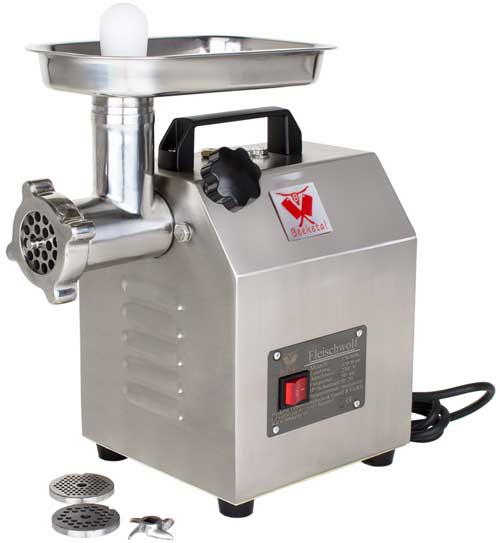
A meat grinder cuts the meat into small pieces so it can be mixed with the seasoning. Cut the meat into pieces that fit the feed tube before grinding.

Spice grinder or mortar
Freshly ground spices taste best. Use a spice grinder or a mortar, and grind the spices completely. Ready-ground spices also work.

Artificial casings, jars or tins
You can fill the sausage into jars, tins or artificial casings. For jars, I usually use Weck jars. I recommend artificial casings, caliber 45/25 for a smaller diameter or 60/25 for a wider one.
For readers in the EU: you can buy these casings in my German shop. Artificial casings, caliber 45/25, 5 pieces, Artificial casings, caliber 60/25, 5 pieces.
Step-By-Step Instructions
Cut the meat and fat for grinding
Cut the streaky pork and the pork jowl (or pork belly/back fat) into pieces about 3 cm on each side that are suitable for the meat grinder. It is precisely this ratio of 35% lean meat to 35% fat that later gives the bavarian beer liverwurst its creamy, spreadable consistency.

Seal the meat in a bag
Place the chopped meat and fat in a vacuum-sealed bag and seal it. The big advantage of using a vacuum-sealed bag is that no meat juices are lost, and you can use all of them later—this gives the liver sausage extra flavor. Tip: If you don’t have a vacuum-sealed bag, you can alternatively boil the meat in lightly salted water and save the cooking liquid.

Cook the meat at 78 °C
Cook the meat in the bag at 78 °C (172.4°F) for 90 minutes. This low temperature is crucial: if it’s any hotter, the proteins will contract too much; if it’s any cooler, you won’t be able to cook it reliably. This works most accurately in a sous-vide tank; if using a pot, a thermometer will help you keep the temperature constant.

Collect the cooking juices
After cooking, carefully open the bag and catch the juices that have leaked out in a bowl. The juices will be added to the mixture later, adding moisture and flavor. Let the meat cool briefly so you don’t burn yourself when mincing it.

Cut the liver for grinding
Now cut the raw pork liver into pieces suitable for mincing. Important: The liver is intentionally not cooked along with the rest of the ingredients, but is minced raw. This ensures that the liver sausage develops its typical fine, creamy texture during the later cooking process, and the color remains beautiful. Cut away the skin and tendons generously; they’ll be unpleasant to eat later on.

Grind everything through the fine plate
Grind the cooked meat, fat, and raw liver together using the fine-hole disc. I deliberately choose the fine disc because that’s what gives the bavarian beer liverwurst its spreadable texture. If you prefer a slightly coarser and heartier texture, you can also use the medium-hole disc—it’s purely a matter of taste.

Mix with beer, onions and spices
Add the light beer, the onions sautéed in clarified butter, and all the spices (Cure #1, salt, black pepper, marjoram, mace, and cardamom) to the ground meat mixture. Mix everything thoroughly until the sausage mixture is smooth and uniform. The sautéed onions set this apart from the raw version: it has a sweeter, rounder, distinctly Bavarian flavor. Tip: If you prefer a finer texture, you can briefly pulse the mixture in a food processor. Personally, I like it a little coarser.

Fill the jars
Fill the sausage meat into clean canning jars. Press it down firmly to remove any air bubbles, and wipe the rims of the jars clean. Important: Leave at least 2 cm of space at the top before the lid. If you fill the jars too full, the sausage will push its way out from under the lid during canning, and you’ll end up with quite a mess in the canner.

Can at 100 °C for two hours
Seal the jars and place them in the automatic canner or a large pot with a steaming rack. Pour in enough water so that the jars are two-thirds submerged, and process the liver sausage at 100 °C (212 °F) for 2 hours. Only through this processing is the raw liver thoroughly cooked. Then let them cool in a draft-free place and check that all lids are tightly sealed.

Your Bavarian beer liverwurst is ready
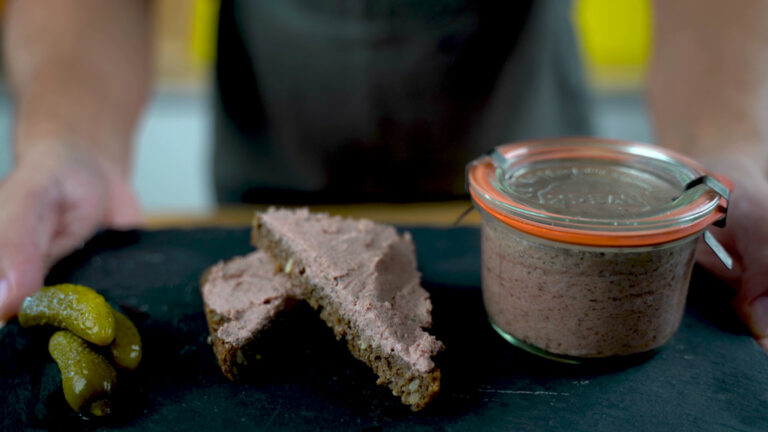
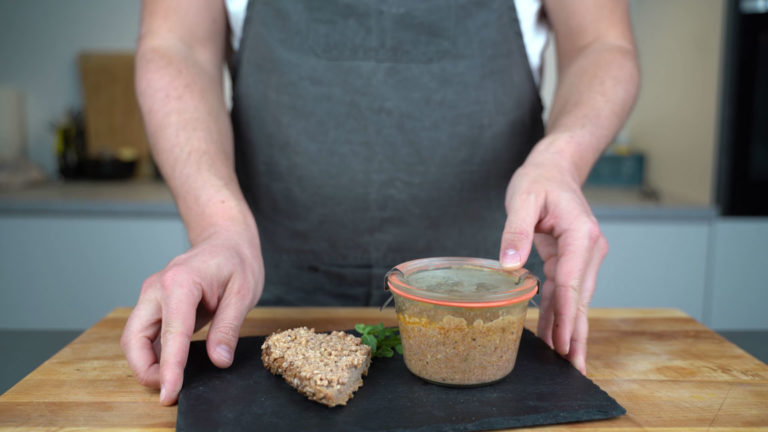
Your bavarian beer liverwurst is ready. The sausage is creamy and spicy, and the light beer comes through subtly in the background without overpowering the other flavors. Serve it on fresh farmhouse bread with a pickled cucumber and a cold light beer, and you’ve got the perfect Bavarian snack on the table. Enjoy!😄
Frequently asked questions
How long does bavarian beer liverwurst last in a jar?
How long does bavarian beer liverwurst last in a jar?
Keep the jars in the fridge and use the liverwurst within 2–3 weeks. Once opened, the jar should be kept in the refrigerator and consumed within 3 to 4 days.
Which beer goes well with bavarian beer liverwurst?
Which beer goes well with bavarian beer liverwurst?
I usually go with a classic light full-bodied beer, preferably a Bavarian Helles or Märzen. The flavor should be mildly malty and complement the liver, not overpower it. I wouldn’t use heavily hopped beers like Pils or IPA, as their bitterness quickly comes through unpleasantly in the finished sausage.
Why is the liver added raw to the mixture?
Why is the liver added raw to the mixture?
The raw liver ensures the liver sausage develops its characteristic smooth, creamy texture during the subsequent simmering process. If you were to cook the liver along with the rest of the mixture, it would lose precisely this binding quality, and the sausage mixture would become grainy instead of spreadable. When simmered at 100 °C (212 °F) for 2 hours, the liver is thoroughly cooked, so you don’t need to worry about that.
Do I absolutely need Cure #1?
Do I absolutely need Cure #1?
If you’re making cooked sausage in a jar, I definitely recommend using Cure #1. It gives the sausage its characteristic pink color. If you use regular salt, the sausage will turn gray. Keep the jars in the fridge and use the liverwurst within 2–3 weeks.
Can I also stuff the bavarian beer liverwurst into natural casings?
Can I also stuff the bavarian beer liverwurst into natural casings?
Yes, instead of using jars, you can stuff the mixture into artificial casings or properly calibrated natural casings and cook it in a water bath at 78 °C to 80 °C (172–176 °F) until the internal temperature reaches 72 °C. However, when cooked in a jar, keep it in the fridge and use it within 2–3 weeks.
Why do I sauté the onions first?
Why do I sauté the onions first?
Sautéed onions add a sweet, rounded depth that raw onions can never achieve. Just sauté them briefly in clarified butter or lard until translucent—they shouldn’t brown. Raw onions work too, but I find that the sautéed version makes the bavarian beer liverwurst noticeably more appealing and pairs better with light beer.