Kolbasz – a Hungarian classic with lots of paprika


- Type
- Cured sausage
- Level
- Advanced
- Rating
- Rate this recipe
In this article, you will learn how to make kolbasz yourself. The preparation takes a while, but it’s definitely worth it!
Kolbasz is a Hungarian raw sausage that is cold-smoked after drying, giving it its typical aroma and long shelf life. Temperature, humidity, and, above all, patience play a decisive role in ensuring successful maturation and smoking.
The following is important to me: Of course, raw sausage is best cured in a curing cabinet. However, there is also the option of doing without one, as I explain in this article.
If you are new to the world of raw sausage making, I definitely recommend my detailed article on making salami yourself.. There you will find all the important information you need to get started.
Now it’s time to get started..
Here you can find the complete Kolbasz recipe as a video or to read through.
Have fun and good luck making it!

Table of Contents
Kolbasz – What do you need to make it?

The perfect ingredients and a little patience are all you need to prepare this tasty treat in no time at all.
Ingredients per 1 kg
| Ingredient | Grams | Percent |
|---|---|---|
| marbled pork | 700 g | 70 % |
| pork loin fat | 300 g | 30 % |
Spices per 1 kg
| Ingredient | Grams |
|---|---|
| salt | 27.5 g |
| sweet paprika | 4.5 g |
| sugar mixture (50% dextrose / 50% sugar) | 3 g |
| Cure #1 | 2.5 g |
| black pepper | 2.5 g |
| rose paprika | 2.5 g |
| fresh garlic | 1.5 g |
The equipment to make Kolbasz
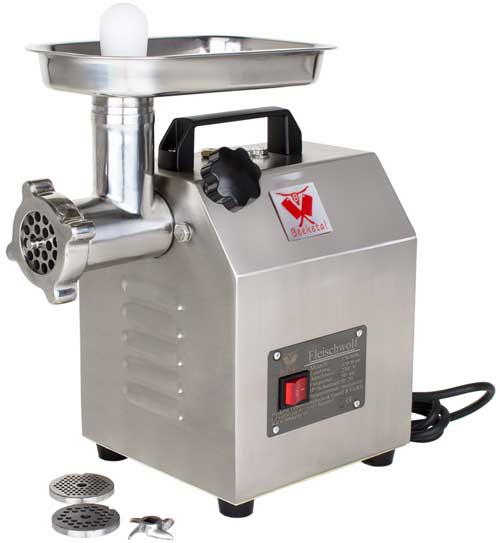
A meat grinder cuts the meat into small pieces so it can be mixed with the seasoning. Cut the meat into pieces that fit the feed tube before grinding.

Sausage stuffer, grinder attachment or funnel
Use a sausage stuffer to fill the mixture into its casing. A stuffing attachment for your meat grinder or a hand funnel also works when you are starting out.

Place to dry and mature the sausage
To age this raw sausage, you need an environment where both humidity and temperature are relatively constant. There are several possibilities for this. I have already matured cured sausages in the fridge or cellar without any problems.
Optional: If you want to be on the safe side, then a ripening cabinet is the best choice. My recommendation: Dry Ager DX 500
Smoker
You need the smoker to smoke your kolbasz.
Natural casings
The kolbasz is stuffed into natural casings. I recommend you to use pork casing caliber 28/30.
Kolbasz – Step-By-Step Instructions
Follow these simple steps to prepare your Kolbasz to perfection.
Cut the pork and pork back fat into pieces suitable for mincing. You can adjust the size depending on how big your meat grinder is.

Place the pieces of meat in the freezer for 1-2 hours to freeze. This will help you later when mincing and ensure that the mixture does not get too warm.

Now you can grind the meat. Depending on how coarse or fine you want your kolbasz, you can use different perforated disks. To be honest, this is completely a matter of taste. I use the medium perforated disk (5 mm) for the kolbasz.

Peel the garlic cloves and remove the outer skin. You can now either chop the garlic finely or use a grater or garlic press to make a fine paste.
Add the spices and garlic to the mixture and knead thoroughly until it reaches a uniform, sticky consistency. This step is important to ensure that the sausage meat binds well. You can also use a hand mixer for this. However, make sure that the sausage meat binds well (approx. 3-4 minutes).

Fill your sausage meat into casings. I use pork casings caliber 28/30 for this.
Ultimately, it is up to you whether you prefer to make thinner or thicker sausages. As with the degree of fineness, this is a matter of taste and can be decided by you. It is important that the casing is suitable for raw sausages. Make sure there are no air pockets. If there are any, you can pierce them with a needle.

Now twist the sausage into rings. You can decide for yourself how large you want your rings to be. To do this, press the sausage to the desired length with two fingers on each hand and rotate it forward a few times. Then skip one sausage length and repeat the process.

Hang the kolbasz to cure for 48 hours in high humidity (>90%) and temperature (20–25 °C / 68.0 – 77.0°F). You can spray the kolbasz with water every now and then to maintain the highest possible humidity.

You can then hang them up in any cool place for a week. The humidity should be around 75-80 % and the temperature no higher than 15°C (59.0°F). If you don’t have a curing cabinet, you can often hang them up in the basement if the conditions are reasonably suitable. I did this for a long time.

You can now hang them in the smoker and cold smoke them. I did three rounds here. That means eight hours of smoke and eight hours without smoke. Ideally, the temperature should be between 15 and 20 degrees Celsius (59.0 – 68.0 °F).

Your kolbasz is now ready. You can either eat it straight away or leave it to mature further in the cellar (< 15°C (59.0°F)). The firmer you want it to be, the longer you need to leave it to mature. Enjoy! 😄
Frequently asked questions
What makes a kolbasz Hungarian?
What makes a kolbasz Hungarian?
The paprika does, and the list above carries two of them for a reason. Sweet paprika brings the colour and the round, fruity base; rose paprika brings the heat. Together with the fresh garlic they are what separates a kolbasz from any other cold-smoked raw sausage, which is why the spice list spends more of its weight on paprika than on pepper.
Which paprika you buy matters more here than almost anywhere else in sausage making. A tired jar from the back of the cupboard gives you a pale sausage with no aroma however patiently you dry and smoke it, because there is nothing else in the recipe carrying that flavour. Buy both grades fresh, Hungarian if you can get them, and set the ratio between the two to the heat you want. That ratio is the one dial in this recipe that is genuinely yours.
What is the shelf life of your kolbasz?
What is the shelf life of your kolbasz?
Your kolbasz can be kept for several months. However, it will gradually lose more moisture and eventually dry out completely. It therefore makes sense to store it vacuum-sealed in the fridge.
Which types of meat are best suited for kolbasz?
Which types of meat are best suited for kolbasz?
Kolbasz is usually made from a mixture of pork (e.g., shoulder or belly) and pork back fat. You can also add beef—the important thing is to have a good balance between lean meat and fat (approx. 70:30).
Do I really need a dry ager?
Do I really need a dry ager?
A dry ager is ideal as it keeps the temperature and humidity constant. However, you can also do without one – e.g. in a cool, well-ventilated cellar. It is important that the temperature (approx. 12-15 °C / 54–59°F) and humidity (approx. 75-80 %) are as stable as possible.
How do I achieve the typical Hungarian flavor?
The secret lies in the quality and quantity of the paprika, as well as the balance between salt and garlic.
The sausage mixture is too dry – what should I do?
Next time, add more fat (pork back fat).
Can I also make spicier varieties?
Sure! You can use more rose paprika or chili, for example. You can adjust the spices to suit your taste.