
How to make Fuet – A delicious Spanish Salami at home


- Type
- Cured sausage
- Level
- Advanced
- Rating
- Rate this recipe
In this post, I’ll show you how to make your own Fuet. It takes some time to prepare, but it’s definitely worth it!
Fuet is a tender, aromatic raw sausage from Catalonia that can be enjoyed in a variety of ways – on its own on a tapas platter, with cheese and olives, as a hearty snack with wine or beer, on fresh bread or in salads.
The production of air-dried sausage such as fuet presents a number of challenges, especially if you have no experience with curing raw sausage. Among other things, the right temperature, the right humidity and, of course, a bit of dexterity are important.
Maturing in a special maturing cabinet is ideal – but don’t worry: there are also alternative methods that work without this – I’ll go into this in more detail in this article.
If you’re trying your hand at making homemade sausage for the first time, I also recommend a detailed article on making salami yourself. There you will find all the important information to help you get started.
Now it’s time to get started..
Here you can find the complete fuet recipe as a video or to read through.
Have fun and good luck making it!

Table of Contents
Fuet – What do you need to make it?
The perfect ingredients and a little patience are all you need to prepare this tasty treat in no time at all.

Ingredients per 1 kg
| Ingredient | Grams | Percent |
|---|---|---|
| lean pork | 800 g | 80 % |
| pork loin fat | 200 g | 20 % |
Spices per 1 kg
| Ingredient | Grams |
|---|---|
| dry white wine (e.g. a Spanish Verdejo – you can also use a wine of your choice) | 50 ml |
| salt | 29.5 g |
| fresh garlic | 7.5 g |
| sugar mixture (50% dextrose / 50% sugar) | 5 g |
| white pepper | 3.5 g |
| Cure #1 | 2.5 g |
The equipment to make fuet
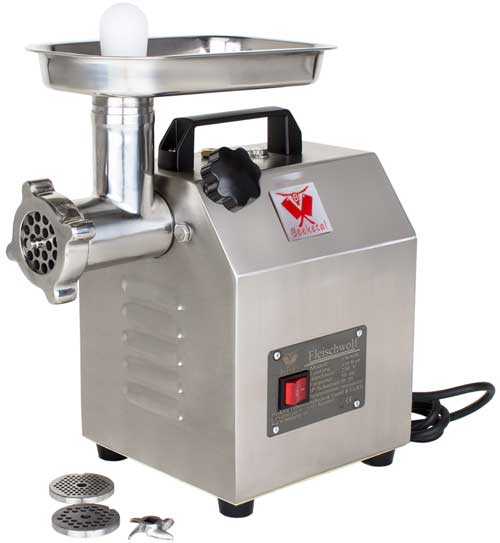
A meat grinder cuts the meat into small pieces so it can be mixed with the seasoning. Cut the meat into pieces that fit the feed tube before grinding.

Sausage stuffer, grinder attachment or funnel
Use a sausage stuffer to fill the mixture into its casing. A stuffing attachment for your meat grinder or a hand funnel also works when you are starting out.

Place to dry and mature the sausage
To age this raw sausage, you need an environment where both humidity and temperature are relatively constant. There are several possibilities for this. I have already matured cured sausages in the fridge or cellar without any problems.
Optional: If you want to be on the safe side, then a ripening cabinet is the best choice. My recommendation: Dry Ager DX 500
Natural casings
The fuet is stuffed into natural casings. I recommend you to use pork casing caliber 28/30.
Fuet – Step-By-Step Instructions
Follow these simple steps to prepare your Fuet to perfection.
Cut the pork and the pork loin fat into mincer-sized pieces. You can adjust the size depending on how big your grinder is.

Place the pieces of meat in the freezer for 1-2 hours to freeze. This will help you later when mincing and ensure that the mixture does not get too warm.

Peel the garlic cloves and remove the outer skin. You can now either finely chop the garlic or process it into a fine paste using a grater or garlic press.

Now you can mix the spices and garlic paste with the wine. This will ensure that the spices are evenly distributed throughout the raw sausage.

Now you can grind the meat. Depending on how coarse or fine you want your fuet, you can use different perforated disks. To be honest, this is completely a matter of taste. I use the medium perforated disk (5 mm) for the fuet.

Add the spices to the mixture and knead it thoroughly until it reaches a uniform, sticky consistency. This step is important to get a good binding of the sausage meat. You can also do the mixing with a hand mixer. But really make sure that the sausage meat gets a good binding (approx. 3-4 minutes).

Fill your sausage meat into casings. Whether you use natural or artificial casings is up to you. It is important that the casing is suitable for raw sausages. Make sure that there are no air pockets. If there are, you can pierce them with a needle.

Now turn off. You can decide for yourself how big your fuet should be. The important thing here is that you either twist in the opposite direction (i.e. 1x forwards and 1x backwards) or alternatively twist one sausage forwards, then leave one out and twist it forwards again.

Hang the fuet to redden for 48 hours at high humidity (> 90%) and temperature (20-25 degrees Celsius, 68–77 °F). You can spray the fuet with water from time to time to keep the humidity as high as possible.

You can then hang them up in any cool place. The humidity should be around 75 % and the temperature no higher than 15 C° (59.0°F). If you don’t have a ripening cabinet, you can also hang them in the cellar in many cases if the parameters are reasonably suitable. I did this for a long time.

After the aging time, your Fuet is ready. This varies greatly depending on which caliber you use and what your environmental conditions are like. Important: The maturing process takes time. Be patient until you reach your desired degree of hardness. Have fun trying it out!😄
Frequently asked questions
What is the shelf life of your fuet?
What is the shelf life of your fuet?
Your fuet can be kept for several months. However, it will gradually lose more moisture and eventually dry out completely. It therefore makes sense to store it vacuum-sealed in the fridge.
Which types of meat are best for fuet?
Which types of meat are best for fuet?
Traditionally, lean pork with a little back fat is used. The ratio is usually around 80 % lean meat and 20 % fat.
What is fuet actually?
What is fuet actually?
Fuet is a traditional, air-dried raw sausage from Catalonia (Spain).
What is the difference between fuet and salami?
What is the difference between fuet and salami?
A fuet is a salami, in the way that a baguette is a bread. Both are raw sausages that are cured, fermented and then dried until they are firm enough to slice, and if you can make one you can make the other. What marks the fuet out is Catalonia’s own set of choices inside that method.
It goes into a thin casing rather than a fat one, so it dries faster and you get more skin against meat in every slice. It is seasoned sparely, with garlic, white pepper and a dry white wine instead of the paprika or the coarse black pepper a Spanish chorizo or an Italian salami leans on. And it is ground finer than most, which is what gives it the smooth, even grain rather than a mosaic of fat. The result is milder and more aromatic than a salami, and it is meant to be eaten in thin slices on its own.
Do I really need a dry ager?
Do I really need a dry ager?
A dry ager is ideal as it keeps the temperature and humidity constant. However, you can also do without one – e.g. in a cool, well-ventilated cellar. It is important that the temperature (approx. 12-15 °C, 54–59 °F) and humidity (approx. 75-80 %) are as stable as possible.
How long does the fuet take to dry?
How long does the fuet take to dry?
The aging time is usually 2 to 4 weeks, depending on the temperature, humidity and desired degree of drying. The longer the maturing time, the more intense the flavor.
How can I tell if my fuet has aged properly?
How can I tell if my fuet has aged properly?
It should be evenly dry, but not rock hard. Look out for unpleasant odors or slimy spots – these are signs of incorrect ripening.
Cuánto debe reducir El Fuerte en la maduración ? 30% igual que la Coppa hay que pesarlos uno a uno y controlar la merma? Gracias